Super Visa Canada 2026: Requirements, Income Table, Insurance and Fees for Parents and Grandparents
The super visa lets parents and grandparents of Canadians and permanent residents stay up to five years at a time. Here is what the host must earn, what the insurance must cover and how to avoid a refusal, checked against IRCC pages in November 2026.
Quick answer
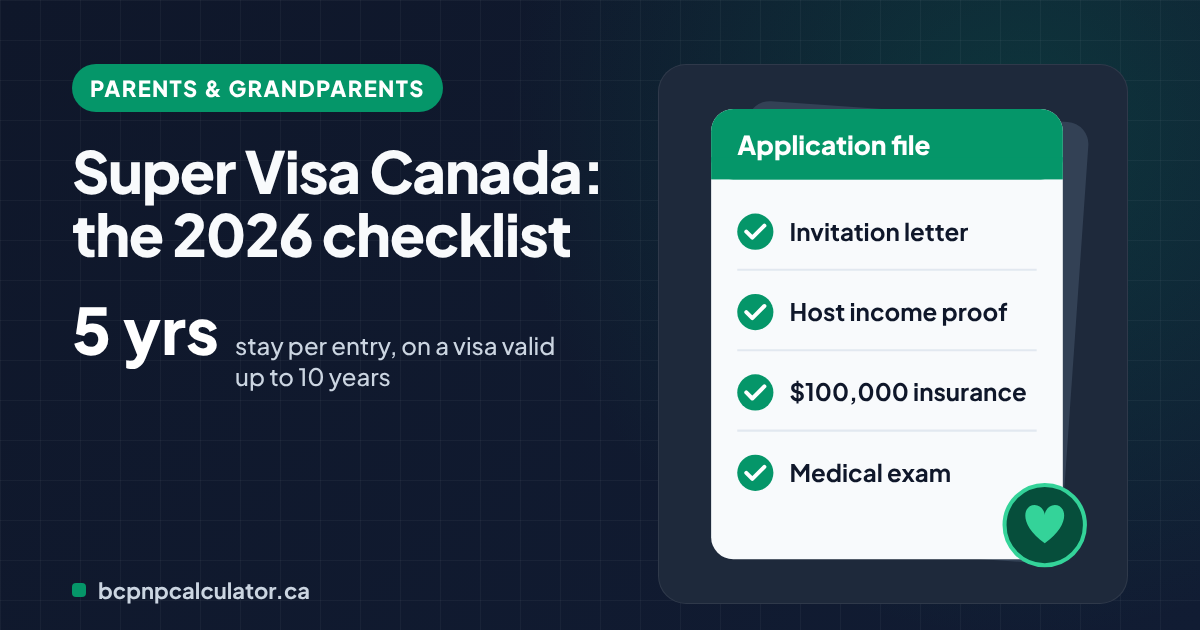
The Parent and Grandparent Super Visa is a multiple-entry visitor visa valid for up to 10 years that lets you stay up to 5 years per entry. Your host child or grandchild must be a Canadian citizen, permanent resident or registered Indian who meets IRCC's minimum income for the family size ($38,002 for a family of two in the current table). You need a medical exam and at least one year of Canadian or OSFI-authorized insurance with $100,000 of coverage. The fee is $100 plus $85 for biometrics.
A super visa is the closest thing Canada has to a long-term family visit permit. It does not give your parents permanent residence, a work permit or provincial health coverage, but it does let them spend years with you instead of the six months a regular visitor normally receives. Because the sponsorship route for parents is closed to new applicants for now, many families in B.C. and across Canada are turning to it. This guide explains the rules as they stand on November 13, 2026. It is general information, not legal advice; IRCC officers decide every case on its own facts.
Who Qualifies for a Parent and Grandparent Super Visa
There are two sides to every super visa: the applicant (the parent or grandparent) and the host (the child or grandchild in Canada). Both have to meet IRCC's requirements.
Host requirements
- Is your biological or adopted child or grandchild, and you can prove it, for example with the host's birth certificate naming you.
- Is a Canadian citizen, a permanent resident or a registered Indian under the Indian Act.
- Is at least 18 and lives in Canada.
- Meets or exceeds the minimum necessary income for the family size (explained below).
- Writes and signs a letter of invitation that promises financial support for the visit.
Applicant requirements
- Is outside Canada when the application is submitted.
- Is admissible to Canada (no serious criminality or security issues, and passes the medical exam).
- Has private health insurance that meets IRCC's rules, valid for at least one year from entry.
- Meets the general visitor test: the officer must be satisfied you are a genuine visitor who will leave at the end of your authorized stay, looking at your ties to your home country, the purpose of the trip, and your family and financial situation.
You cannot include dependent children in a super visa application. If both parents are coming, each applies in their own name; they can apply together and are counted in the same family size. Citizens of visa-exempt countries can also get super visa approval: they receive a letter to show the border officer instead of a visa sticker, and still need an eTA if they fly in.
How Long You Can Stay on a Super Visa
For anyone who applied on or after June 22, 2023, IRCC says super visa holders are "eligible to stay for 5 years at a time." The visa itself is a multiple-entry visa that can be valid for up to 10 years, so a parent can come for an extended stay, go home, and return on the same visa. IRCC notes that a super visa cannot be valid longer than your biometrics, and visa offices set the actual validity case by case, so not everyone receives the full 10 years.
If you want to stay past the date you were authorized, apply to extend your stay from inside Canada before your status expires. IRCC's fee list shows $100 per person to extend a visitor stay as of November 2026. Leaving it too late is costly: restoring lapsed visitor status costs $246.25. You remain a visitor throughout, which means no work in Canada and no B.C. Medical Services Plan coverage, so the insurance policy matters for the whole stay.
The Super Visa Income Requirement in 2026
The host must show they can support everyone in the household. IRCC publishes a minimum necessary income table by family size. Older articles describe it as the low income cut-off plus 30%; IRCC's current page simply lists the dollar amounts, so use the table below rather than calculating it yourself.
| Family size | Minimum income (CAD) | 75% (Option 2 floor) |
|---|---|---|
| 1 person | $30,526 | $22,895 |
| 2 people | $38,002 | $28,502 |
| 3 people | $46,720 | $35,040 |
| 4 people | $56,724 | $42,543 |
| 5 people | $64,336 | $48,252 |
| 6 people | $72,560 | $54,420 |
| 7 people | $80,784 | $60,588 |
| Each person beyond 7 | add $8,224 | - |
Table as published by IRCC, marked "Updated July 29, 2025," and still current on IRCC's page as of November 13, 2026. The 75% column is our arithmetic, rounded up to the next dollar.
Counting the family size correctly
Under-counting is one of the easiest ways to fail the income test. The family size includes the super visa applicants applying together, the host, the host's spouse or common-law partner (in some cases even a separated spouse), the host's dependent children whatever the custody arrangement, anyone previously approved for a super visa under a letter of invitation from the host or their partner that still applies (even if that person is not in Canada now), and anyone the host sponsored or co-signed for whose undertaking is still in effect. A host with a partner and two children inviting both parents is a family of six, so the bar is $72,560.
Two ways to meet it since March 31, 2026
IRCC announced on March 20, 2026 that, from March 31, 2026, the income test became more flexible, and it applied the change to applications already in process. The host's page now describes two options:
- Option 1: the host (plus any co-signer) meets the full amount in either of the two tax years before the application, proven with a Canada Revenue Agency notice of assessment. A strong year two years ago can now count if last year was weaker.
- Option 2: the host and co-signer reach at least 75% of the minimum in the year before the application, and the visiting parent's or grandparent's own income covers the gap. The applicant must document that income (pay stubs, employer letter, bank statements, pension statements or rental documents) and show they will keep receiving it while in Canada, in the currency they are paid in.
Only the host's spouse or common-law partner can co-sign, and they must also be a citizen, PR or registered Indian. Siblings cannot pool income. The notice of assessment is the preferred proof; under Option 2, if it is not available, IRCC accepts a T4 or T1, 12 months of pay stubs, an original employer letter with job title, duties and salary, bank statements showing regular deposits, or other proof such as pension statements and lease contracts.
Planning tip for newcomers
Hosts who arrived recently may not have two Canadian tax years yet. If your parents' visit depends on your income, look at the timing of your first full tax year in Canada, and see our guide on how to immigrate to Canada with family for planning the whole household's move.
Super Visa Insurance Requirements
The insurance rule is strict and is checked again at the border. According to IRCC, the policy must:
- Come from a Canadian insurance company, or from a foreign company authorized by the Office of the Superintendent of Financial Institutions (OSFI) that appears on OSFI's list and issued the policy while doing insurance business in Canada. A foreign policy must say so in writing. Brokers and claims administrators are not insurers.
- Cover health care, hospitalization and repatriation.
- Provide at least $100,000 of emergency coverage.
- Be valid for at least one year from the date of entry, and be valid for each entry.
- Be paid in full, or in instalments with a deposit. A quote is not accepted.
- Name the insurer and be available for a border services officer to review on request.
Premiums vary with age, health, deductible and pre-existing condition coverage, so compare the stability clause and exclusions, not just the price. A cheap policy that excludes a known heart condition may meet the visa rule but leave the family with a large hospital bill.
The Immigration Medical Exam
Super visa applicants must have an immigration medical exam with an IRCC panel physician; your own doctor cannot do it. IRCC tells super visa applicants to get the exam before applying (an "upfront" exam) and include the confirmation document the panel physician gives you. You pay all exam costs at the appointment, they are not refunded if the visa is refused, and the results are valid for 12 months. If your parents do not travel within that window, they may need a new exam.
Super Visa Fees and Processing Times
| Cost | Amount (as of November 2026) |
|---|---|
| Super visa (multiple-entry visa) | $100 per person (not charged to visa-exempt applicants) |
| Biometrics | $85 per person, maximum $170 for a family applying together |
| Extend stay in Canada | $100 per person |
| Restore visitor status | $246.25 |
| Medical exam and insurance | Paid to the panel physician and insurer; varies |
Processing times depend on where the applicant lives. IRCC's processing-time tool, last updated November 4, 2026, showed these super visa estimates (biometrics not included):
| Applying from | Super visa estimate |
|---|---|
| United States | 75 days |
| India | 85 days |
| China | 89 days |
| Pakistan | 101 days |
| United Kingdom | 104 days |
| Philippines | 109 days |
For comparison, the same update showed 32 days for a regular visitor visa from India and 24 days from the Philippines. If speed matters more than length of stay, read our guide to Canada visitor visa processing times. Check the IRCC tool yourself before booking flights, since the estimates change every week.
How to Apply for a Super Visa, Step by Step
- Confirm the host's income against the table, using the right family size and choosing Option 1 or Option 2.
- Book the medical exam with a panel physician and keep the confirmation document.
- Buy the insurance from an eligible insurer, paid in full or with a deposit, starting on the planned entry date.
- Get the letter of invitation signed by the host (and co-signer, if any), listing every person in the family size with names and dates of birth.
- Gather proof of the host's citizenship, PR or Indian status, the relationship (birth or baptismal certificate), and income.
- Apply online through the IRCC Portal from outside Canada and pay the fees. Paper or alternate formats are only for people who cannot apply online.
- Give biometrics as soon as you receive the instruction letter, then send the passport when the visa office asks for it.
Super Visa vs Visitor Visa vs Parents and Grandparents Program
| Feature | Super visa | Visitor visa | PGP sponsorship |
|---|---|---|---|
| Status | Visitor | Visitor | Permanent resident |
| Stay | Up to 5 years per entry | Usually up to 6 months | Permanent |
| Host income test | Yes | No | Yes, over several years |
| Insurance and medical | Both required | Medical only in some cases | Medical required |
| Open now? | Yes | Yes | Paused for new applicants |
IRCC's Parents and Grandparents Program page says it is not accepting applications and will not accept new interest to sponsor forms or invite sponsors until further notice, while existing applications continue to be processed. If you already have a sponsorship in process, IRCC allows your parents to apply for a super visa while they wait. A regular visitor visa makes sense for shorter trips or when the host cannot meet the income test.
If your own permanent residence is still in progress, your parents cannot get a super visa on your invitation yet, because the host must already be a citizen, PR or registered Indian. For B.C. residents working toward PR, our BC PNP spouse and family guide covers who can come with you, and the BC PNP Calculator estimates your registration score.
Common Super Visa Refusal Reasons
- Income below the threshold, often because the family size left someone out, such as a parent approved on an earlier invitation or a person still under a sponsorship undertaking.
- Insurance that does not qualify: a foreign insurer not authorized by OSFI, coverage under $100,000, less than a year of validity, missing repatriation, or a quote instead of a paid policy.
- Doubts about leaving Canada: weak ties to the home country, an unclear purpose for a long stay, or a past immigration violation.
- Missing documents, such as no proof of the relationship, no medical exam confirmation, or an invitation letter without names and dates of birth.
- Medical or criminal inadmissibility identified through the exam or background checks.
A refusal letter usually names the reason. Fixing that specific issue before reapplying is more useful than resubmitting the same file. For complex histories, consider a licensed immigration consultant or lawyer.
Frequently Asked Questions
How long can parents stay in Canada on a super visa?
Up to 5 years at a time. For anyone who applied on or after June 22, 2023, IRCC says super visa holders are eligible to stay for 5 years per entry, and the visa itself allows multiple entries for up to 10 years (IRCC says it cannot be valid longer than your biometrics). You can apply to extend from inside Canada before your status runs out; the fee to extend a visitor stay is $100 per person as of November 2026.
What is the super visa income requirement in 2026?
The host child or grandchild, plus a co-signing spouse if needed, must meet IRCC's minimum necessary income for the family size. The table IRCC currently publishes (updated July 29, 2025) starts at $30,526 for one person, $38,002 for two, $46,720 for three and $56,724 for four. Since March 31, 2026 the host can meet it in either of the two tax years before applying, or reach at least 75% of it in the previous year and top up the rest with the visiting parent's own income.
What insurance do I need for a super visa?
Private medical insurance from a Canadian insurer, or a foreign insurer authorized by OSFI that issued the policy while doing insurance business in Canada. It must cover health care, hospitalization and repatriation, provide at least $100,000 in emergency coverage, be valid for at least one year from each entry, and be paid in full or in instalments with a deposit. Quotes are not accepted.
How much does a super visa cost?
IRCC's fee is $100 per person, plus $85 for biometrics if you need to give them (the biometrics fee is capped at $170 for a family applying together). Visa-exempt applicants do not pay the $100 visa fee. On top of that you pay the panel physician for the medical exam and buy the insurance policy, which is usually the biggest cost.
How long does super visa processing take?
It depends on the country you apply from. IRCC's processing-time tool, last updated November 4, 2026, showed 85 days for applicants in India, 89 days in China, 101 days in Pakistan, 104 days in the United Kingdom and 109 days in the Philippines. Biometrics are not included in those estimates.
Can I sponsor my parents for permanent residence instead?
Not right now through a new application. IRCC's Parents and Grandparents Program page says it is not accepting applications or new interest to sponsor forms until further notice, while it keeps processing existing files. The super visa is the main long-stay option while the PGP is paused, and you can hold a super visa while a sponsorship you already filed is in process.
Can a parent bring dependent children on a super visa?
No. The super visa is only for parents and grandparents of the host, and dependants cannot be included. Each parent or grandparent applies in their own name, although both members of a couple can apply at the same time and be counted in the same family size.
Sources
- Super visa for parents and grandparents, IRCC
- Super visa: who can apply, IRCC
- Super visa: how long you can stay, IRCC
- Super visa: forms and documents (insurance and letter of invitation), IRCC
- Super visa: proof of financial support (minimum income table), IRCC
- Changes to how the super visa income requirement is calculated (March 20, 2026), IRCC
- Super visa: submit your application, IRCC
- Medical exam requirements for temporary residents, IRCC
- IRCC fee list
- Check processing times, IRCC
- Sponsor your parents and grandparents, IRCC
Information current as of November 13, 2026. Processing times are from IRCC's tool update of November 4, 2026. Fees, income thresholds and program status change; confirm on IRCC's website before applying.