Canada Visitor Visa Processing Time (November 2026): TRV Wait Times by Country, Fees and Tips
What IRCC's own data says about how long a temporary resident visa takes, what the number actually measures, and how to avoid the delays that push your file past it.
Quick answer
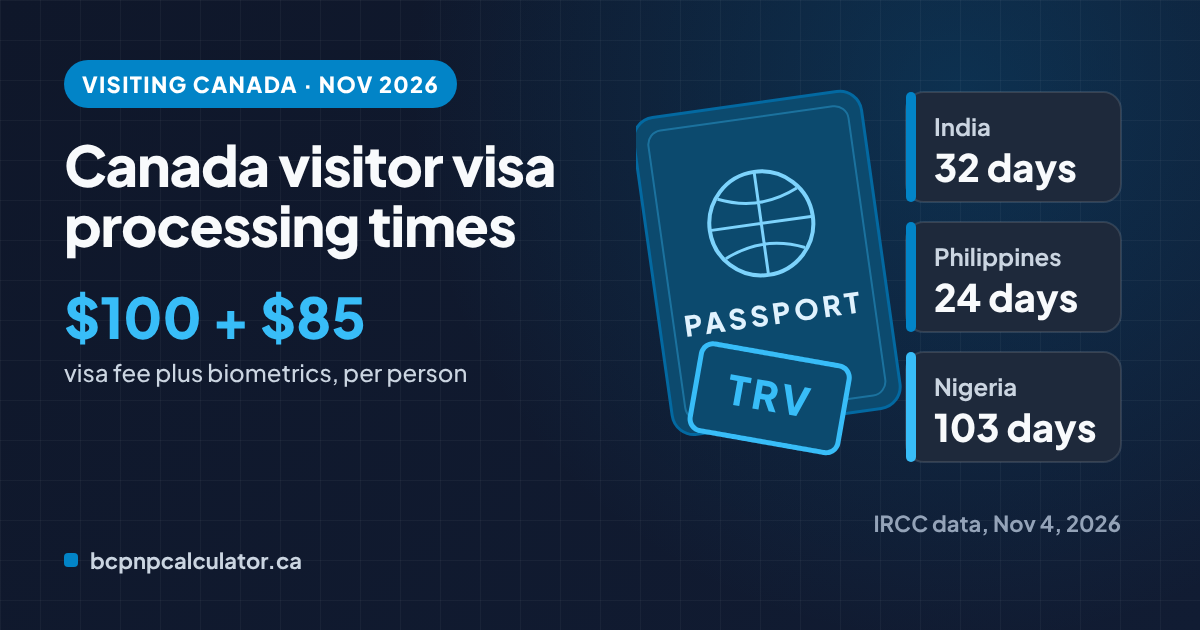
A Canada visitor visa (temporary resident visa, or TRV) applied for from outside Canada currently takes anywhere from about two weeks to more than three months, depending on the country you apply from. IRCC's figures, last updated November 4, 2026, show 32 days for India, 24 days for the Philippines, 51 days for China, 58 days for Pakistan and 103 days for Nigeria. The figure includes biometrics and reflects how long IRCC took to finish 80% of recent applications. The fee is $100 per person plus $85 for biometrics.
If a parent, sibling or friend wants to visit you in Vancouver, Surrey or Kelowna, the first question is usually how long the visa will take. The honest answer is that it depends heavily on where they apply from, and the number IRCC publishes is a look backward at recent files rather than a guarantee. This guide pulls the current figures straight from IRCC's processing-time data, explains how to read them, and covers the fee, the form, the eTA alternative and the reasons applications stall. It is general information, not legal advice.
Canada Visitor Visa Processing Times by Country (November 2026)
IRCC publishes visitor visa processing times by the country you apply from, which is normally where you live. The figures below were read from the data behind IRCC's official processing-time tool, which IRCC lists as last updated November 4, 2026. We have added the super visa time for the same countries because many B.C. families compare the two.
| Applying from | Visitor visa (outside Canada) | Super visa |
|---|---|---|
| India | 32 days | 85 days |
| Philippines | 24 days | 109 days |
| China | 51 days | 89 days |
| Pakistan | 58 days | 101 days |
| Nigeria | 103 days | 33 days |
| Vietnam | 39 days | 46 days |
| Bangladesh | 31 days | 53 days |
| Iran | 76 days | 231 days |
| Mexico | 14 days | 78 days |
| United States | 18 days | 75 days |
| United Kingdom | 23 days | 104 days |
Source: IRCC processing-time data, last updated November 4, 2026, retrieved November 13, 2026. Times change weekly; check the official tool before you apply.
A few things stand out. Applications from Mexico, the United States and the Philippines are currently among the fastest, while Nigeria and Iran are among the slowest. The United States, United Kingdom and Mexico rows matter mostly for people who live there but hold a passport that needs a visa, for example an Indian citizen working in California; U.S. citizens do not need a visa at all, and U.K. citizens use an eTA. The Nigeria row is not a typo: the published super visa time (33 days) is shorter than the visitor visa time (103 days), because each line comes from a different pool of applications.
IRCC's data also lists a separate figure of 310 days for extending your stay as a visitor (a visitor record) from inside Canada, as of November 4, 2026. If your relative is already here and wants to stay longer, apply for the extension well before their current status ends.
What the Visitor Visa Processing Time Actually Means
IRCC says most of its processing times are historical. For temporary residence applications such as visitor visas, it looks at how long it took to process 80% of applications over the past 8 to 16 weeks. So if the tool says 32 days, roughly eight in ten recent applications from that country were decided within 32 days, and two in ten took longer. IRCC states plainly that the times are "not a maximum or a guarantee."
- When the clock starts: the day IRCC receives your complete application. For online applications, that is the day you submit.
- When it stops: when an officer makes a decision. Sending your passport for the visa to be placed in it happens after that.
- Biometrics are included: IRCC says the processing time includes the time it takes to give your biometrics. A slow appointment booking therefore eats into, and can push past, the posted figure.
- Updates: the figures change as backlogs grow or shrink, so a time you saw last month may be out of date.
Canada Visitor Visa Fees in November 2026
These amounts are from IRCC's fee list as of November 13, 2026, in Canadian dollars:
| Item | Fee |
|---|---|
| Visitor visa, including super visa (per person) | $100 |
| Visitor visa, family of 5 or more applying together | $500 |
| Biometrics (per person) | $85 |
| Biometrics, family applying together (maximum) | $170 |
| Extend your stay as a visitor (per person) | $100 |
| Restore your status as a visitor | $246.25 |
| Electronic Travel Authorization (eTA) | $7 |
For a single first-time applicant, that is $185 in total. Children under 14 and applicants over 79 are exempt from biometrics, and U.S. nationals do not give biometrics for temporary residence applications. Fees are paid by card at the end of the online application.
Visitor Visa or eTA: Which One Do You Need?
Your passport decides this, not where you live:
- Visitor visa required: citizens of visa-required countries, including India, Nigeria, China, Pakistan, Vietnam, Bangladesh and Iran, need a visitor visa for any way of travelling to Canada, including by car, bus or cruise ship.
- eTA required: citizens of visa-exempt countries, such as the United Kingdom, France, Japan and Australia, need an eTA to fly to or through a Canadian airport. It costs $7 and IRCC says most are approved within minutes. No eTA is needed if they arrive by land or sea.
- Neither: U.S. citizens and U.S. lawful permanent residents (green card holders).
- eTA instead of a visa, for some: citizens of certain visa-required countries, including Mexico, the Philippines, Brazil, Thailand, Indonesia and Malaysia, can apply for an eTA if they are flying, are coming for a temporary stay (normally up to six months), and have either held a Canadian visitor visa in the past 10 years or currently hold a valid U.S. nonimmigrant visa. Travel by land or sea still requires a visitor visa.
If your relative qualifies for the eTA route, it is usually far quicker than waiting weeks for a TRV. Use IRCC's "Find out if you need a visa" tool to confirm before booking flights.
How to Apply: Form IMM 5257 and the Documents You Need
The official form is IMM 5257, Application for visitor visa (temporary resident visa). Most applicants now apply online through the IRCC portal, the new version of the portal (for adults applying alone for the first time without a representative) or the IRCC secure account, where the IMM 5257 questions are built into the online form. Paper applications are only for people who cannot apply online, for example because of a disability, or who travel with a refugee, stateless or non-citizen travel document.
Typical documents
- A copy of a valid passport. IRCC advises it should be valid for at least six months from your travel date.
- Proof of funds, such as recent bank statements, showing you can pay for the trip.
- A letter from your employer or other proof of a job, business, studies or property at home.
- Your travel history and a simple itinerary.
- For family visits, a letter of invitation from your relative in Canada and proof of your relationship.
- A letter authorizing a minor to travel, if a child is travelling without both parents.
- Anything your country's visa office checklist adds; the portal generates a personalized list.
After you submit
- You receive a biometrics instruction letter. Book a visa application centre appointment straight away; the letter states your deadline.
- An officer reviews the file and may ask for more documents, an interview, a medical exam or a police certificate.
- If approved, you get a letter asking you to send your passport. You cannot travel until the visa is placed in it, and you should send the same passport you applied with.
A visitor visa can be issued for up to 10 years or until the passport or biometrics expire, whichever comes first, but the officer decides the actual expiry date and many visas are issued for less.
Visitor Visa vs Super Visa for Parents and Grandparents
Parents and grandparents of Canadian citizens, permanent residents and registered Indians can apply for a super visa instead of a regular visitor visa. A super visa lets them stay for up to five years at a time, with multiple entries over up to 10 years, while a regular visitor normally stays up to six months. The government fee starts at the same $100, but the super visa asks for more: proof of the host's income, medical insurance and a medical exam among the required documents. As the table above shows, it is also slower from most countries, often by two months or more. For a short trip, a regular visitor visa is usually the faster choice. Our super visa guide covers the requirements in detail.
How to Check Your Visitor Visa Application Status
- Your online account: sign in to whichever account you applied through: the IRCC secure account (GCKey or Sign-In Partner) or one of the IRCC portals (email sign-in). Messages, biometrics letters and the decision all appear there.
- Application status tracker: an optional separate account that can show a more detailed timeline. You need your unique client identifier (UCI) and application number.
- Paper applications: link the application to an IRCC secure account to follow it online.
If your application is well past the posted processing time for your country, you can then contact IRCC through its web form. Before that point, enquiries rarely change anything.
Why Visitor Visa Applications Get Delayed or Refused
Common causes of delay
- Waiting days or weeks to book biometrics after the instruction letter arrives.
- Requests for more documents, an interview, a medical exam or a police certificate.
- Submitting a different passport from the one in the application.
- Peak seasons and visa offices with large backlogs, which is why the same visa can take 14 days from one country and over 100 from another.
Common reasons for refusal
IRCC's eligibility rules say a visitor must have a valid travel document, be in good health, have no criminal or immigration-related convictions, have enough money for the stay, and convince an officer that ties such as a job, home, financial assets or family will take them home at the end of the visit. Refusals usually trace back to one of those points: the officer was not convinced the person would leave, the funds looked thin or unexplained, the purpose of the trip was vague, or documents were missing. An incomplete application can be refused outright. The refusal letter explains the reason, so read it before you reapply, and only reapply when you can address it with new evidence.
Practical tips for B.C. hosts and their visitors
- Apply at least the posted processing time plus a month before the trip, and longer around holidays or family events.
- Write a clear invitation letter with your address in B.C., your status in Canada, who is paying for what, and the planned dates.
- Show the visitor's own reasons to return: a job letter, business registration, property records or family at home.
- Check whether they qualify for an eTA before paying for a visa.
- Don't book non-refundable flights until the visa is in the passport.
Planning to bring family over permanently rather than for a visit? Read how to immigrate to Canada with your family and our BC PNP spouse and family guide. If you are a temporary worker in B.C. thinking about your own path to permanent residence, see the 2027 temporary resident cap explainer and estimate your score with the BC PNP Calculator.
Frequently Asked Questions
How long does a Canada visitor visa take in November 2026?
It depends on the country you apply from. IRCC's processing-time data, last updated November 4, 2026, shows 32 days for applications from India, 24 days from the Philippines, 51 days from China, 58 days from Pakistan and 103 days from Nigeria for a visitor visa applied for from outside Canada. These are historical figures: the time it took IRCC to finish 80% of recent applications, not a promise for yours.
Does the visitor visa processing time include biometrics?
Yes. IRCC says the processing time includes the time it takes to give your biometrics. The clock starts on the day IRCC receives your complete application and ends when an officer makes a decision. Mailing your passport for the visa counterfoil after approval comes on top of that, so leave a margin before your flight.
How much does a Canada visitor visa cost?
As of November 13, 2026, IRCC's fee list shows $100 per person for a visitor visa (including a super visa) and $500 for a family of five or more applying together. Biometrics cost $85 per person, or a maximum of $170 for a family applying at the same time. An eTA costs $7. Fees are in Canadian dollars.
What is form IMM 5257?
IMM 5257 is IRCC's Application for visitor visa (temporary resident visa). Most people now apply online, where the same questions are built into the IRCC portal or secure account, so you may never download the PDF. Paper applications are only for people who cannot apply online, for example because of a disability, or who travel on a refugee, stateless or non-citizen travel document.
Do I need a visitor visa or an eTA to visit family in B.C.?
Citizens of visa-required countries such as India, Nigeria, China and Pakistan need a visitor visa. Citizens of visa-exempt countries such as the United Kingdom, France or Australia need a $7 eTA to fly to Canada. U.S. citizens and U.S. lawful permanent residents need neither. Citizens of some visa-required countries, including Mexico and the Philippines, can use an eTA instead if they fly and have held a Canadian visitor visa in the past 10 years or hold a valid U.S. nonimmigrant visa.
Can I speed up my Canada visitor visa application?
There is no paid express service for ordinary visitor visas. What you can control is avoiding delays: apply online, upload every document on your checklist, book biometrics as soon as the instruction letter arrives, answer any request for information quickly, and submit the same passport you used in the application. Contacting IRCC before the posted processing time has passed usually does not move a file forward.
Why was my visitor visa refused?
The most common reason is that the officer was not satisfied you would leave Canada at the end of your visit, often because of weak ties to your home country, unclear finances or an unclear purpose. Missing documents can also lead to a refusal. Your refusal letter in your IRCC account explains the reason; read it carefully before you reapply with stronger evidence.
Sources
- Check processing times (method, 80% rule, biometrics included), IRCC
- Processing-time data by country (last updated November 4, 2026), IRCC
- Processing-time data, applications inside Canada (last updated November 4, 2026), IRCC
- Fee list, IRCC
- Apply for a visitor visa, IRCC
- Application for visitor visa (IMM 5257), IRCC
- Visitor visa: who can apply, IRCC
- Visitor visa: after you apply, IRCC
- Entry requirements by country, IRCC
- eTA for select visa-required countries, IRCC
- Apply for an eTA, IRCC
- Biometrics, IRCC
- Super visa for parents and grandparents, IRCC
- Check your application status, IRCC
Information current as of November 13, 2026. Processing times are IRCC's figures last updated November 4, 2026. Times and fees change; confirm on IRCC's website before you apply.